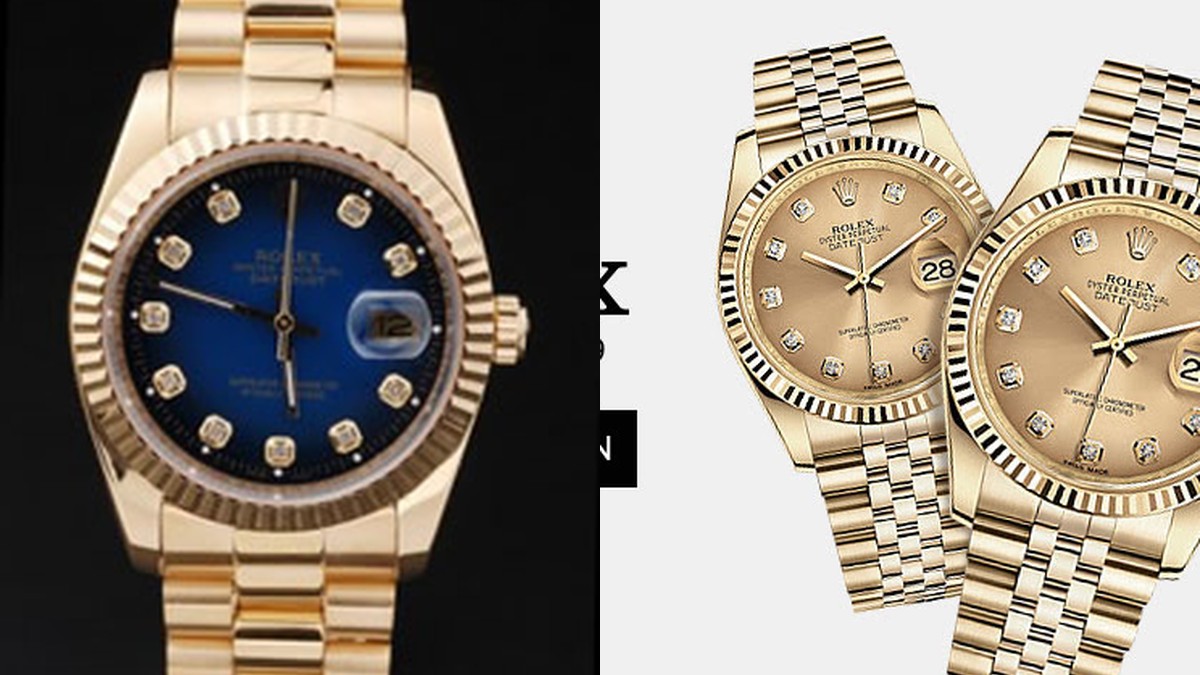
The date window tells the story
The Datejust looks straightforward until the eye starts following the date window. The Cyclops, dial spacing, bezel, case profile and bracelet all meet in a small area, so one proportion error can make an otherwise clean watch feel wrong. Current Datejust references provide a useful visual target, but the replica still has to be judged as a complete watch rather than by one headline feature.
Rolex introduced the Datejust in 1945. The historically important point is that it brought an automatically changing date displayed in a window on the dial within a self-winding chronometer wristwatch. Modern Datejust references are offered in multiple sizes and configurations. Datejust 41 reference 126334, for example, uses a 41 mm case, calibre 3235, a Cyclops lens and 100 m water resistance on the genuine watch.
A Datejust should read correctly from arm’s length
A Datejust is visually simple enough that proportion errors are easy to notice. Start with the relationship between the bezel, dial opening, lugs and bracelet. On a fluted-bezel configuration, the depth and angle of the flutes change how the entire watch reflects light. On a smooth-bezel configuration, poor polishing and the wrong bezel height are more obvious.
The Jubilee bracelet is another strong signal. Genuine Jubilee uses five-piece links and has a distinct visual softness compared with the three-piece Oyster bracelet. On a replica, check whether the end links meet the case cleanly, whether the bracelet tapers naturally and whether the clasp sits flat on the wrist.
Cyclops and calendar: small parts, big tells
The date display is the most useful close-up area on a Datejust replica. Look straight at the watch rather than judging from an angle. The date should sit centrally within the aperture, the font should be consistent and the Cyclops should line up with the window. Excessive or weak magnification is noticeable, but alignment is usually the more important first check.
Then test function. A watch that looks good in a still photograph can have a rough quick-set date, a date that begins changing too early, or a crown position that feels uncertain. The genuine Datejust 41 uses calibre 3235 with instantaneous date and rapid setting. A replica movement will often differ, so the goal is not to pretend it is 3235—it is to verify that its date mechanism behaves reliably and that the visible result is correctly positioned.
What the movement changes above the dial
The Datejust is mechanically less demanding than a Daytona because it only needs three hands and date. That makes several movement architectures viable. A genuine Swiss automatic movement can be an excellent practical choice if case dimensions and stem height are engineered around it. Japanese movements such as MIYOTA 8215 or 9015 are also common alternatives in watches across the broader replica market.
The trade-off is often between visual architecture and practical serviceability. A movement decorated to resemble Rolex calibre 3235 may look closer through a removed caseback, while an established generic calibre may be easier to replace or service. Since the standard Datejust has a closed caseback, movement reliability and correct hand/date behavior often matter more to the wearer than decorative finishing hidden inside.
36 and 41 are different designs, not just different sizes
One common QC mistake is to compare a 36 mm replica with photographs of a 41 mm genuine watch or vice versa. The larger model does not simply scale every component evenly. Dial spacing, bezel-to-dial ratio, lug presence and bracelet width change the visual balance. Confirm the intended size first, then compare like with like.
This is especially important for diamond dials or two-tone models because extra visual detail can distract from incorrect case geometry. A dramatic dial does not compensate for a case that sits too tall or a bezel that is too wide.
Metal, bezel and bracelet finish
Replica listings still use familiar categories—yellow-gold tone, Everose-style color, steel and diamond-set dials—but terms such as “18k,” “904L” and “real diamonds” should not be accepted from appearance alone. Gold-colored components may be plated or coated. Steel grade requires more than a photograph. Gem setting can be inspected for alignment and consistency even when the stone material itself has not been independently tested.
Judge the finish you can see—polish transitions, brushing direction, bezel edges, marker setting—separately from the material composition you cannot prove visually.
A practical Datejust inspection sequence
- Confirm 36 mm or 41 mm and the exact bezel/bracelet configuration.
- Check dial alignment and marker spacing in a straight-on photo.
- Inspect Cyclops alignment and date centering with several date values.
- Check fluted-bezel geometry or smooth-bezel polish under side lighting.
- Inspect Jubilee/Oyster end-link fit and clasp alignment.
- Test crown positions, quick-set date and hand setting.
- Verify the actual movement rather than the seller’s tier label.
- Request pressure-test evidence if the watch will be exposed to water.
The last check belongs to the actual watch
The Datejust is a model where small alignment errors matter more than dramatic marketing claims.
Open QC ChecklistReference consistency matters more than isolated “perfect” details
A Datejust replica can have an excellent dial and still feel wrong if the bezel, case and bracelet belong visually to different generations. Check the whole configuration before grading individual details. Is the intended watch 36 or 41 mm? Is the bezel fluted or smooth? Is the bracelet Jubilee or Oyster? Does the dial style belong to that case and metal combination? A reference-consistent watch usually looks more convincing at normal wrist distance than one with a few spectacular macro details but mismatched proportions.
Rehaut and crystal height are useful secondary checks
After basic proportions and date alignment, inspect the rehaut—the inner flange between dial and crystal. Engraving should follow the dial cleanly and the coronet/reference alignment should not look randomly rotated. Crystal height also affects how the bezel and Cyclops appear from the side. An excessively proud crystal or thick gasket can make the watch look taller and change reflections around the date lens.
These are secondary checks because camera angle can exaggerate them. Use several photographs before treating a slight visual difference as a defect.
Date-change timing: what matters in daily use
A genuine modern Datejust is engineered for an instantaneous date change, but many replica movements will not reproduce the exact behavior. What matters practically is consistency and correct final alignment. If a replica begins its date transition earlier and completes it gradually, that should be disclosed rather than described as identical to Rolex. A buyer who values visual accuracy at midnight may care; another buyer may prioritize movement durability.
Test quick-set date operation away from the movement’s restricted calendar-change window. For generic movements, follow the movement manufacturer’s own setting guidance rather than assuming Rolex instructions apply.
Jubilee bracelet finishing deserves a wrist-level test
Macro photographs can make a Jubilee bracelet look impressive while hiding stiffness. Hold the bracelet horizontally and observe how the links articulate. Check whether the bracelet drapes naturally, whether the clasp is centered, and whether edges catch the skin. The five-piece visual pattern contains many surfaces, so inconsistent polishing or plating becomes noticeable during movement.
On two-tone versions, compare the color of center links, bezel and crown. Small mismatches in gold tone can be more obvious on the wrist than tiny dial-printing differences.