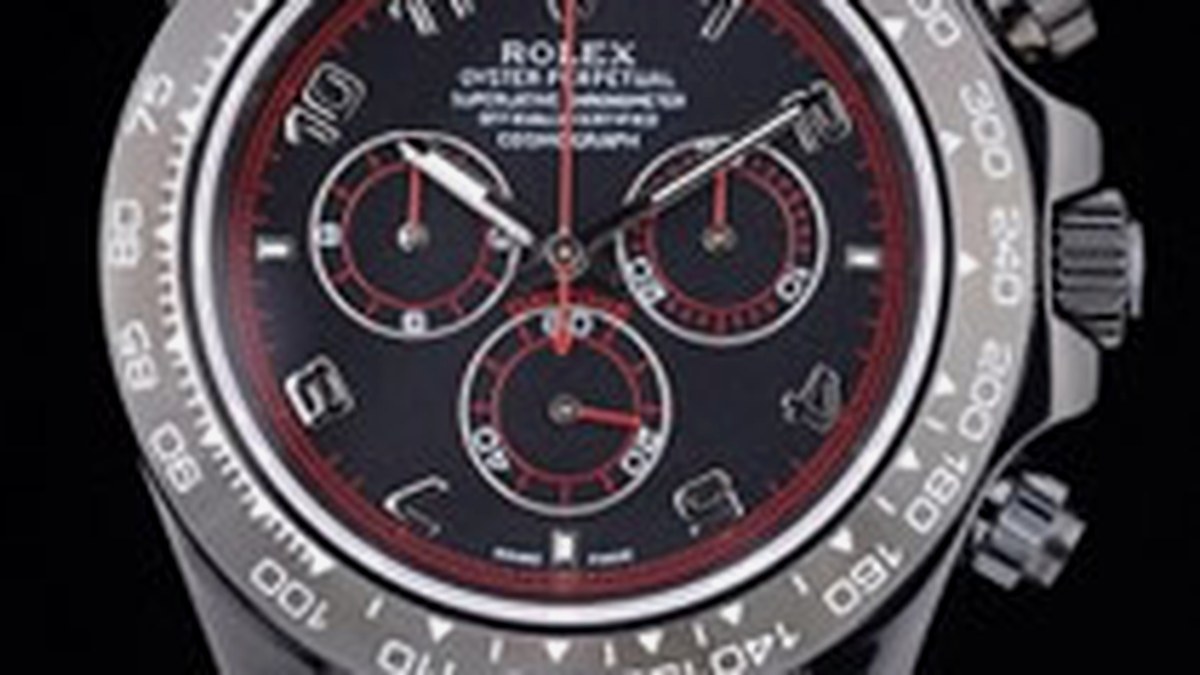
A chronograph leaves nowhere to hide
The original Daytona page argued that replicas could provide the visual appeal of the Cosmograph without the cost of precious materials. That framing overlooked the real technical challenge: the Daytona is difficult to reproduce because its chronograph architecture determines what the dial looks like. A movement choice that changes subdial positions, hand height or total thickness can make an otherwise well-finished watch look wrong.
Current genuine Daytona reference 126500LN uses a 40 mm Oystersteel case, Rolex calibre 4131, a black Cerachrom tachymeter bezel and 100 m water resistance. The chronograph uses central seconds, a 30-minute counter at 3, a 12-hour counter at 9 and small seconds at 6. Those positions are the correct visual map for this reference.
Subdials reveal the architecture underneath
When a replica is advertised as a “clone Daytona,” ask what movement architecture actually drives the chronograph. Some movements can reproduce the visible layout more closely than others. A decorated rotor or bridge does not correct subdials that sit too far from the center, nor does it fix a case made too thick to accommodate a different movement stack.
Operate the chronograph. The start/stop pusher should engage consistently, the chronograph seconds hand should move as intended, elapsed-time counters should advance, and the reset should return the relevant hands to zero. A watch that only resembles a chronograph in a static photo belongs in a different quality category from one whose functions operate coherently.
Thickness is part of the movement story
Daytona copies often reveal their movement choice through the dial. Compare the radial distance of each subdial from the center, the size of the subdial rings and where the hands pivot. Then inspect the watch from the side. If the movement requires additional modules or a different hand stack, the case may become noticeably taller than the genuine reference.
Do not judge thickness only from a seller’s listed number. Side photographs showing the bezel, mid-case, caseback and crystal are more useful because they show where the extra height is coming from.
The outer hardware matters as much as the dial
The bezel is one of the Daytona’s defining features. On current ceramic-bezel references, inspect the clarity and spacing of the tachymetric scale and the alignment of markings around the bezel. On older metal-bezel references, the finish and engraving style differ, so make sure the watch is being compared to the correct generation.
Pusher shape matters too. Screw-down pushers and the crown should sit naturally relative to the crown guards. Overlarge pushers, shallow threading or uneven gaps are easier to spot in side-angle photos than in a straight-on glamour image.
Reading the dial at reset
Chronographs contain more visual information than simple three-hand watches, which gives low-quality printing more places to fail. Check the Rolex coronet, line spacing, hour markers, subdial markings and the central chronograph hand. After resetting, the chronograph hand should return cleanly to its zero marker rather than resting slightly to one side.
Lume and marker alignment should also be judged as a set. One misaligned index may be more noticeable on a high-contrast dial than a small color difference that appears only under macro photography.
What a “Swiss-made Daytona” claim is actually saying
“Swiss made” is often used as a shortcut for quality, but on a Daytona it says very little unless the actual calibre and chronograph functions are identified. A useful listing should name the actual calibre, state whether the chronograph is fully functional, and provide a realistic description of service options. If the movement is Swiss but the subdial layout is wrong for the reference, the country of origin does not solve the visual problem.
Likewise, a high-beat movement can produce a smooth-looking seconds motion but still be unsuitable for the intended chronograph layout. Evaluate architecture, operation and case integration together.
Run the chronograph before you judge the finish
- Match the watch to the correct Daytona reference and bezel generation.
- Compare all three subdial positions and diameters.
- Start, stop and reset the chronograph more than once.
- Check whether elapsed-time counters actually advance.
- Inspect case thickness from both crown and non-crown sides.
- Check pusher threading and crown-guard geometry.
- Inspect tachymeter alignment, dial printing and the reset position of the chronograph seconds hand.
- Verify the movement calibre independently of decorative engravings.
Current 126500 versus older 116500 comparisons
Daytona replica discussions often mix the previous 116500LN generation with the current 126500LN. They are visually related but not identical. The current reference introduced revised case and dial details together with calibre 4131. When a seller advertises a “126500” watch, compare it to current 126500 reference photos rather than accepting a generally modern ceramic Daytona appearance.
This matters because factories may update dials and bezels before fully revising case geometry. A transitional-looking product is not automatically poor, but it should be described accurately so the buyer knows which details are current and which remain based on the prior generation.
Chronograph hand behavior reveals more than rotor decoration
Observe the central chronograph seconds hand from start through reset. It should start consistently, run without obvious stutter, and return to its zero marker. Then watch the minute and hour counters during an extended test. A movement can reset cleanly in a 15-second video while a counter fails to advance correctly over time.
For serious QC, ask for a function video long enough to demonstrate that at least the minute counter changes. This is one of the strongest ways to separate a functional chronograph from a dial that merely looks correct.
Caseback thickness and movement stack
Replica Daytona cases often become thick underneath because the installed movement or module requires extra vertical space. Side photographs should show the relationship between bezel, mid-case and caseback rather than only an overall thickness number. A deeply protruding caseback changes wrist feel even when the visible upper case looks accurate.
Hand-stack clearance matters for the same reason. If chronograph hands sit unusually high above the dial, additional movement or dial spacing may be present. These clues help explain the architecture without opening the watch.
Bracelet and clasp are part of the sports-watch character
The Daytona’s Oyster bracelet should not be treated as a generic steel strap. Check taper, brushing, polished surfaces, end-link fit and clasp operation. On precious-metal-style or two-tone replicas, coating consistency across case and bracelet matters. A strong head with a weak bracelet makes the whole watch feel lower tier during daily wear.